
As part of my Asian trip this autumn, I also visited the land of the rising sun for the second time following my first visit in May 2018. Similarly to my first visit, my main focus were the F-4EJ and RF-4EJs of the Japan Air Self Defense Force, resident at Hyakuri Air Base. Two squadrons remain operational at this base, but they are enjoying their last operational days in service with the Japanese Air Force due to the impending entry into service of the F-35 Lightning. Thus, my aim was to try and make sure to enjoy the last remaining phantoms as much as possible.
I spent 7 days travelling through Japan, mainly visiting air bases in the area of Tokyo. I also aimed to try and spend a day at Komatsu Air Base, since last time I came the weather was not that great for photography. Similarly to May last year, the weather varied from day to day, with days of full sunshine and days full of clouds and rain.
Following our arrival from Taiwan, the first day was spent in the approach at Atsugi. The original plan was to attend the Shimofusa airshow, however due to the recent typhoons that affected Japan the airshow was cancelled. However, I still managed to bag varied types of the Japanese Navy at Atsugi, namely 2 Kawasaki P-1s, a C-130R, and a very rare LC-90, another first of the type for me.


Based on the weather forecast, the second day of spotting was spent at Komatsu Air Base. As usual activity was plentiful with loads of F-15 Eagles taking off for their morning and afternoon missions, including the specially adorned F-15J Eagles of the Koku Senjyutsu Kyododan (Aggressor) Squadron. Both runways were in use due to the varying wind conditions, which ensured that we got the best out of both runways to end a very successful day at this air base. A bonus for me was the presence of two T-400 aircraft that are usually based at Miho air base, that landed for a tech stop at Komatsu. These were the first of this particular type to add to my collection.


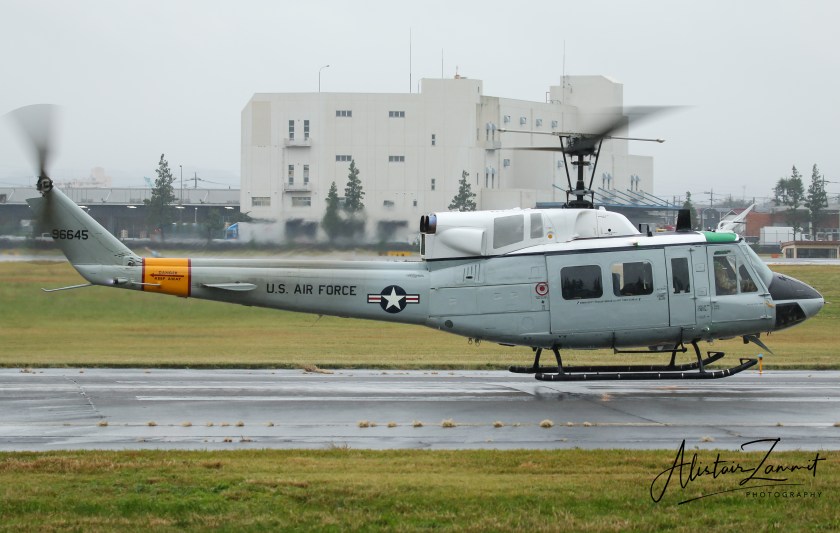
The weather forecast for the following day presented cloudy weather in almost all of Japan, so I opted to proceed to bases were at least the scenery allowed some contrast on the photos. This led me to Iruma air base, owing to the fact that at this air base you can shoot aircraft taxiing past against a background full of greenery. As usual, the base was full of activity despite the rain which hampered a bit our ability to take decent shots of the aircraft at times. Later on we moved to Yokota Air Base, where me managed to see capture a rare USAF Huey that forms part of a squadron of Hueys permanently stationed at Yokota Air Base.
The forecast for the following day showed sun at Hyakuri, so I found myself early at the gates of the Hyakuri peace Towers to hopefully see some activity of the based phantoms. The day was great, despite the lower levels of flying activity experienced, owing to the fact that one squadron that I had seen in May 2018 had disbanded. Still, we managed to see two RF-4 phantoms in the morning (one in the blue and another in dark green livery) as well as 7 grey phantoms take off for their morning missions. In the afternoon, we witnessed a wave of 4 F-4EJ phantoms and two blue RF-4s. We also witnessed some visiting aircraft at the base, such as two T-4s from Hamamatsu and one CH-47J Chinook from Iruma Air Base. All in all a great day, as is always the case when visiting Hyakuri.


The following final two days were spent at Iruma air base , mainly to capture the arrivals for the airshow that was planned for the coming weekend, and witness also some flights by C-1s and YS-11s, aircraft that are permanently based there and are soon going to be retired. We also scheduled a second visit to Hyakuri however when we arrived there we noted that no aircraft were going to fly on that day so we quickly relocated to Iruma again.


This brought and end to my trip to Japan and to my Asian trip in 2019. It was brilliant, with plenty of action and diversity, and loads of photographs. I can’t wait to come again to Japan, this time i might try my luck in the southern part, especially to focus on the P-3s and F-2s that are found in abundance in this region of Japan. On to the next one!
 alistairzammitphotography.com